Sunday, October 10, 2021

"He Returned, Still Grieving"

Today's Gospel holds so much to meditate on. The traditional homily of the rich young man focuses on attachments - what are the areas in your life that you cling to? What do you need to sell in order to follow Christ? Where is Christ leading you, and what do you need to leave behind?

Alternatively, we can talk of our need for childlike dependence on the Father who loves us: where do you see yourself as rich, independent of God, and how can you realize your poverty? What holds you back from receiving all that Our Lord is offering you? What are you afraid of losing because you don't yet trust Him to provide everything for you?

Or we can discuss the promise of the hundredfold - the invitation and the promise that come along with following Christ. Where are you holding yourself back? Where are you feeling stuck, and what journey and adventure does He have in store for you?

But this morning in prayer, the line that stuck out above all was - 

He was shocked and went away grieving, for he had many possessions. (Mk 10:22)

Goodness. A cursory reading would seem to be a condemnation on the rich man's disordered attachments to things of this world, or a suggestion that we need to easily be able to say like Peter, Look, we have left everything and followed you. I do think that's part of it, because one of the goals of the spiritual life is detachment[1]. We should never forget the goal (though even detachment is a means to a more beautiful end, a deep and intimate union with Our Lord).

At the moment though? I'm struck by Jesus's posture of one who, looking at him, loved him. There is such tenderness in that look of love, and everything I know of Christ tells me His gaze was not contingent on a particular posture or attitude on the part of the rich man. The man's inability to easily give up everything might prevent him receiving that loving look and all the gifts that come with it, but they are always being offered.

One of the literary brilliances of this passage is what we don't hear: we don't hear what happens to the rich man after he leaves. While we typically imagine him walking away and saying I'm not willing to give this up, what I saw this morning was instead a view of the man's return:

Along the journey, a young man came to Jesus, knelt before him, and said "Teacher, I was rich, but now I have nothing. Can I follow you now?" His quavering voice and swollen eyes showed the pain he carried, and it was not with an ease that he spoke of his loss.

Jesus, looking at him, loved him. "I know how difficult that was for you. I have also given things up for the sake of the kingdom, so thank you for being willing to do it."

"I didn't do it willingly, Lord. I just knew I had to - I feel like something precious has been stripped away. Will you still let me follow you, knowing that part of my heart holds this against you? I feel like you asked me for too much."

Jesus, looking at him, loved him. "I understand. Grieving is necessary, and I'm with you in this. The fact that it was this hard makes your sacrifice all the more beautiful, and all the more powerful. It warms my heart to know that you have returned. It was never the grieving that was the problem, it was the going away."

Beloved - in this life Our Lord asks us to give up things for the kingdom. Sometimes they are small, or they are attachments we know aren't good for us. He asks us to give up our sins, and the reasons are clear. Sometimes we understand in the moment that it is for a greater purpose, and we may even catch glimpses of that greater purpose.

Other times, though? Other times it feels like we were never given a choice in the matter. Something was simply taken, and we had no say - we simply suddenly found ourselves without. Whatever that loss is, we find ourselves wanting to cry out to God: What are you doing? How could you do this - why did you take this from me? Willing sacrifices are painful, but we are the ones holding the knife and in one sense if feels like we are in control.

But when God decides for us what we will no longer have? That grieving takes ... well, maybe a lifetime. You find yourself asking that same Why? question so often. And I have to confess that, at least in my own case, the lack of an understandable answer for some time left me with a distinct lack of peace. As if God's Loving Will is only acceptable if I understand it or see the fruits.

Sometimes a need for understanding is our way of trying to maintain control over a situation we never had a say in.

Sometimes, all we can do is ask for the grace to accept without seeing. Without knowing. Without understanding. We have to stop trying to get it, let go of all control, and truly abandon ourselves to Our Lord.

That does not mean a lack of tears, or sorrow, or inability to sleep, or eat, or function - grieving is natural, and necessary, and He is always with us in all circumstances.

When the now-poor young man returned to Our Lord, grief-stricken over his own loss, Jesus never begrudged him for the grief. Looking on him, he loved him. And when the steps forward from what he had left behind became painful for the hundredth time, Our Lord took him by the hand, sat with him, and held him as he wept yet again. And he whispered these words of comfort:

"I understand. It won't always be like this for you. I know right now it just seems like too much. I'm here with you. I will never - ever - leave you. One day it will make sense - I know those feel like empty words, and this is not a promise you are interested in hearing, because I know right now you just want to return to how things were.

Give me your tears - your heart is precious to me, and I don't just want your adoration and your faithfulness. I want you to come to me when it hurts. When you don't know what to do. When it doesn't make sense. When you want to scream at me for taking away what you felt was most important, or when it just feels unfair. I'm here for all of it - I only ask that you continue to follow me, and give me the chance to heal all these broken parts.

I know right now the hundredfold seems like a worthless treasure, and it is unimaginable that I could give you something greater than what you had. I know. Thank you for continuing to walk with me, for not leaving when part of you still holds this against me. I'm here for all of it. Allow me to enter your heart and expand it - to give you greater desires. To help you receive more of me.

I'm here.

I'm here.

I'm here."


[1] “We should not prefer health to sickness, riches to poverty, honor to dishonor, a long life to a short life. . . . Our one desire and choice should be what is more conducive to the end for which we are created.”

—St. Ignatius of Loyola, The Spiritual Exercises

Saturday, May 1, 2021

On Love and Longing

When you find yourself separated from your beloved, you find an enormous vacancy in your heart - a place of giving and receiving that is no longer filled.

Loving and being loved, knowing and being known, giving and receiving ... all those expressions of love that are no longer there make you painfully aware of that absence.

I think in a lot of ways, we can experience this as a death of love, or see a need to quiet our hearts or come to accept that emptiness - to settle for an existence without that love, or simply try to save ourselves from experiencing heartbreak by convincing ourselves our hopes or dreams or desires had been set too high.

From a Christian perspective ... this is a load of hooey.

We say that God is love, goodness, beauty. Any desires we have in this life are really an expression of a deeper desire for Him. We seek love - giving and receiving - because we were made by love, with love, for love. We are bearers of God's image, called to love deeply, intimately, with a purity and passionate fire.

Loss of love does not negate the existence of that love. It does not destroy that love. Surprisingly, an experience of longing coincides with an awakening of desire, and we might be tempted to look for substitute loves in a million places as we grasp for anything to plug up that hole - to stop the ache. We need friends and family to step in and support us as we recover ... but we should be careful not to turn them into replacements for what we have lost. They won't complete us either, and they will distract us from what we truly need. At a certain point we need to recognize that even the greatest of loves - whatever we have lost - couldn't in principal satisfy the longings of our hearts.

Longing is painful, a pain that is so tempting to quiet. But it speaks to that deeper reality - that deeper and greater love. We grieve the loss of a river we had come to know and love, one which we drank from and enjoyed and rested by ... and it is right to grieve. Loss is a death that must be experienced.

But it is also a call and an invitation to an ocean that is wider and deeper and fuller. An ocean that pre-existed what was lost; which fed that river; which now summons us to something more. A greater love.

But it's not so easy, my friends. Knowing there is an ocean is not the same thing as diving into it. When our hearts are still tied to your lost beloveds - to the past memories, to the future that cannot be, to a present that looks different from what your heart longs for - we are unable to receive from the fullness of what is on offer. We have to detach through separation and distance and a wandering in the desert.

We can't force that process without doing violence to ourselves. We have to honor with reverence the reality of where we are; our experiences, our longings, the truth of what we currently still want. This painful ordeal of letting go takes time, and above all it takes grace - this is holy work, best done through prayer and tears and honesty. Offering our hearts to God, precisely as our hearts currently exist. Asking that He fill them with Himself. Reconstruct them. Piece them back together. Expand them.

~~~~~~~~~~~~~~~~~~~~~~~~~~~~~~~~

Speaking for myself - I have a long way to go. I miss my best friend and my beloved terribly, and while I am trying to let go ... as I said, most of the hard work of detaching is done by God, not by us. I'm trying to be patient, giving God a lot of space to operate, and trying to not think of her. And - yes, I'm also grasping at a million things for some quick fix - but I've grieved before, and I know enough to know those things will only be temporary. But I think the biggest work I'm doing right now is in reflecting on all my desires and dreams and delights, asking Jesus to be the one to fulfill them instead.


Thursday, December 24, 2020

God With Us

Everything I wanted in a Christmas homily today was summed up in these three precious words - "God with us".
I think this year has prepared our hearts for this good news, but also likely challenged our belief and understanding of the phrase - certainly any superficial stances on God's Providential care were out the window by month two of the pandemic, let alone by this time of year, when we are all so weary and worn.
But I want to come back to that phrase, "God with us". The moment we acknowledge that God is in control, that God is at work, that "God is with us", we have painted ourselves into a corner.
Because if God is with us, we are accepting He is with us in all things. Good and bad, better and worse. This is the promise, and we are forced to see the world differently: We are not in control, and that is a good thing.
It can seem so easy to look at the miraculous and see God's Providential care. We can accept the virgin birth, the resurrection, healings and testimonials of recovery from addiction, because of the obviousness of the gift.
But can we trust in "God with us" when things don't seem to get better? When the world seems on fire and people are losing jobs and families are separated and our loved ones are dying? Do we still believe then?
For those of us who choose to trust God, we have found our faith tried - as St. Peter put it, "like gold that has been tested in a fire". We have found our hopes clarified - we cannot cling to anything in this world, because all of it is passing. We have (hopefully) found our love strengthened and refined by witnessing so much suffering, needing creativity in pouring ourselves out.
We can point to the Canon of Scripture to show how God was working throughout Salvation History, preparing a people for the coming of Christ. But we need to point to the Canon of Now just as boldly and declare with our lives, "God is still with us, and He is still working".
When God first came to us, it was in a poor family in a cold stable far from home. But the Holy Family still carried peace and joy in their hearts, even as they were persecuted and fled to Egypt. That sense of belovedness remained with them throughout their lives, even as Joseph died and Jesus left home and was rejected and betrayed and scourged and killed.
They knew that "God with us" is a promise: They are never alone. And they recognized Him in every detail of their lives, both significant and mundane. They saw how God was doing beautiful things in the good, and how God was compassionately standing beside them as they endured the trails.
As we begin this Christmas season, I'm left wondering: what are the conditions I place on seeing "God with me"? Where in my life (the traumas of the past, the pains of the present, the hopes and fears of the future) do I not yet recognize that promise? Where do I need to further entrust myself to Him?
After the darkness and quiet of Advent, where God worked in painful and bitter waiting, I am so glad to be able to celebrate the immediacy of God in the Incarnation (which I have every intention of celebrating the full season). But the true test is in the darkness, when we can't see the light and can only walk by faith. I want to wish you all a very Merry Christmas, and perseverance in seeing God in the here and now - "God with us".

Saturday, September 5, 2020

Wonderings and Clarifications

I just got done having a conversation with a dear trans woman, each of us sharing our stories and talking through our relationship with God and the Church. After I shared my story of transition, conversion, and de-transition, her [1] initial response was that in her view of things, I am in fact a woman, and am living in denial.

I try to be as objective as I can when considering others' thoughts, so just for the moment let's not simply reject the statement outright. I know she meant well, in a sense (though she prefaced her statement with "this might offend you, but ..."). I think there is a well-intended genuine concern here, and I want to honor that - in her world-view, people who see themselves as women truly are women; if that is the case, then to not transition is to deny myself the authenticity of being truly who I was made to be. Such goes the standard transgender narrative.

But I know the other consideration here is that in applying Catholic anthropology to myself (in seeing myself as a man and my body as good), I am also making a statement about her own journey. I can appreciate the concern, and I will admit to hesitating to share my story without first listening to hers. She was right, too - my de-transition within the context of my conversion did speak to a change in my general attitude toward medical and social transitioning in general.

Part of this discussion was also surrounding the wider question of Catholic teachings on sexuality, with my new friend [2] making the rather unfortunate claim that the Church teaches that there is no such thing as homosexuality or being gay. Seeing as that is a total misinterpretation of Church teachings, I was tempted to correct her - but I also know that there is a deep and painful wound here, which doesn't get healed through correcting theological misconceptions.

~~~~~~~~~~~~~~~~~~~~~~~~~~~~~~~~~~~~~~~~~~~~~~~~

I struggle with what to say in these situations, because I get it.

I understand why she began her story feeling a need to justify her transition.

I understand why the conversation felt as much like an argument as it did like an honest and open discussion.

I understand her perspective that I am almost letting down the transgender community in accepting the Church's teachings (not to mention the way that I let down the LGBTQ+ community).

Sometimes people in the Church say terrible and hurtful things, and that must be acknowledged. Wounds are real, rejection is real, pain is real. May I never dismiss anyone's scars. But it's a struggle for sure - this was probably the first time in a few years I have discussed transgender issues with someone who comes at it from an entirely different perspective.

Granted, it's a perspective I used to hold - down to the claim that scientific studies demonstrate the truth of brain-sex theory [3].

~~~~~~~~~~~~~~~~~~~~~~~~~~~~~~~~~~~~~~~~~~~~~~~~

I guess I still feel a need to clarify - I don't hate people who are transgender. Nor do I look down on them, pity them, or see them as being in need of redemption (any more than all of us are in need of redemption). While we may disagree on the merits and morality of transitioning as a treatment for gender dysphoria, and while I may wish that they would accept the fullness of the revelation of God as presented by the Church (and then live according to that revelation), I have no intention of forcing my perspective on anyone. Nor do I intend to force anyone to live according to the ideologies I have chosen to accept as being true.

I do, however, want to make a rather bold claim - anything the Catholic Church teaches in this area is meant to come from a place of love and to lead us to a deeper understanding of ourselves, and is meant to orient us toward loving God.

~~~~~~~~~~~~~~~~~~~~~~~~~~~~~~~~~~~~~~~~~~~~~~~~

The Eden Invitation transgender [4] community recently held a listening session with Shannon, one of the founders. Seeing as we live within a rather specific niche (living according to the teachings of the Catholic Church while also having experiences that often cause people to leave the Church), the question came up - "What do you want the wider LGBTQ+ community to know about your experiences?"

My immediate answer - we're not miserable, and we aren't living empty lives devoid of happiness or meaning.

As I said previously, the standard transgender narrative is that a person who experiences gender dysphoria must transition, or else be doomed to live an inauthentic life. The narrative further expresses the concern that those who insist on living according to the "rules of the Church" are doing so at great cost, and are perhaps even victims of a Church that has a medieval understanding of the human person.

From discussions with those in my community, this claim is so unfortunate because it dismisses the experiences of those of us who subscribe to Church teachings. Even more, it dismisses the experiences of those who experience gender dysphoria and would transition if not for life circumstances (of which there are many).

It would be a mistake for me to attempt to convince anyone of a certain ideology in the context of a blog, but the point I'm making is this: it is possible to live an authentic and meaningful life in while not transitioning. Or, to put it another way - my gender dysphoria is not the entirety of my story.

I experience gender dysphoria. There are days I experience my being male as a great pain and transitioning as a great longing. There is true suffering at times, but there is also true joy. My experiences are real and they are part of who I am, but they do not encompass all of who I am. I struggle to see myself in light of how God sees me, but I also must acknowledge that He knows me better than I know myself and loves me better than I love myself. It is still a wonder that He allows me to experience that disconnect at a times, knowing that it draws me to trust Him and His vision more than even my own perspectives.

I am who God makes me to be, in all that I am, body and soul - and I attempt (rather feebly) to honor that. As a Catholic I embrace that tension because there will never be a moment that we fully comprehend the mystery that is God's plan for our lives; but I have still found that His plan is good and worth following. And while I don't entirely understand what God is revealing in my life, I don't hesitate for a moment to continue following Him.

~~~~~~~~~~~~~~~~~~~~~~~~~~~~~~~~~~~~~~~~~~~~~~~~~~~~

[1] I say "her" because I know both the experience of gender dysphoria as well as the experience of having that experience ignored. I'm of the opinion that you can present the truth of God's view of humanity while also honoring the pain of someone's experiences, and insisting on referring to someone by their biological sex (while true) can exacerbate that pain without providing any opportunity for loving dialogue.

[2] More significantly, she is also my sibling in Christ,  a member of the same Mystical Body.

[2] Brain-sex theory is interesting, because it makes the claim that the brain has the potential of being of a different sex from the rest of the body. If it were true, and if it were further established that the sex of the brain unchangeable, it would be ethical to allow people to medically transition (or at least morally neutral, because there would be objective and demonstrable evidence of the need to align body and mind). The scientific literature remains unclear at best as to the veracity of the brain-sex theory claims (https://www.ncbi.nlm.nih.gov/pmc/articles/PMC7139786/; https://www.centerforfaith.com/blog/sex-gender-and-transgender-experiences-part-4-brain-sex-theory). A more reasonable claim is that our behaviors and desires according to social stereotypes of masculinity and femininity can be attributed to some extent to the way our brains are formed. What that has to do with gender identity remains unclear, and perhaps even unverifiable.

[3] I say "transgender" to simplify the description of our community. Truth be told, we have a variety of experiences, from gender non-conformity to gender dysphoria to body dysmorphia, and not all of us would identify as transgender.


Friday, July 31, 2020

Peace and Wounds

This morning I'm thinking about Our Lord's appearance to the eleven in the upper room, after the resurrection:
On the evening of that first day of the week, when the doors were locked ... Jesus came and stood in their midst and said to them, “Peace be with you.” When he had said this, he showed them his hands and his side. The disciples rejoiced when they saw the Lord. [Jesus] said to them again, “Peace be with you. As the Father has sent me, so I send you.” And when he had said this, he breathed on them and said to them, “Receive the holy Spirit. Whose sins you forgive are forgiven them, and whose sins you retain are retained.” (Jn 20:18-23)
Which is to say, I'm thinking about the wounds in my own life that need healing, and what Our Lord teaches us in His actions about the importance of reconciliation. So, while I'm writing just to work through this in my own life, I'd also like to share some thoughts.

I guess the first thing that occurs to me here is that phrase, the doors were locked. Isn't that always the case in times of conflict? We hide behind locked doors, out of a place of shame or regret or distrust. We get wounded, and rather than immediately reaching out we lock ourselves away. And the wound festers.

What's worse is all that is said in the unspoken words. As we lock ourselves away to heal, we find that healing is not a solitary action. Silence may give us time to make peace with God and stitch ourselves up, but it doesn't bring us real healing. Instead, we begin to make assumptions about what is done and left undone - their intentions and attitudes; subsequent encounters with them; we even question the basis of the relationship and begin seeing even wounds that had previously been healed begin to surface.

Each party finds themselves waiting for the other to reach out, to be the first to build a bridge - and of course, nobody wants to do that because that involves stepping into the unknown realm of will they forgive me? will they apologize? will we be able to recover? As I said, we hide out of distrust.

It is into this locked room full of fear and distrust that Our Lord enters - and mysteriously, He enters speaking Peace. There is so much that could be said about this Shalom, about the unexpected and radical mercy being offered. It is an invitation, of course; but beyond that, I think it also serves as a reminder that the Christian life must be lived in relation to others, and - especially within the Mystical Body of Christ - we should be anxious to reconcile and restore, because what affects one of us affects the entire Body.

All this being said ... I think it would be a mistake to see this Shalom as an excuse to move on without addressing the elephant in the room. I know on an important level, Our Lord showing His wounds is about demonstrating the bodily Resurrection; but beyond that reading, we can see how necessary it is to acknowledge the wounds we have received at the hands of others. It is an act of vulnerability to show others where we have been hurt, inviting them to a place of compassion and empathy, and inviting them to realize the need for reconciliation. We can't just move on, and the peace being offered needs to come with a humble admittance that there is brokenness that requires healing. Otherwise it's just words.

How crucial is it, though, that Our Lord shows His wounds without coming from a place of woundedness? This is not a lashing out - no accusations or finger-pointing, no shouting. Certainly no veiled threat that His offering of peace is contingent on their asking forgiveness. But it occurs to me that He didn't even specifically state what they had or hadn't done; rather, He showed the wounds He had received and invited them to come to see the fault of their inaction in light of their sorrow at the pain He endured.

~~~~~~~~~~~~~~~~~~~~~~~~~~~~~~~~~~

Friends, there are some wounds within the Body of Christ this evening (as if this is at all a surprise). I think it is so much more complicated within the Church, because there is such a temptation to just move on and seek that artificial half-peace of pretending the wounds aren't there. Or generally avoiding dealing with them, as if they will go away. There is a place for giving time to heal and return with cooler heads, but at some point you have to properly heal, rather than simply patching over it.

I have to confess that - insofar as I see myself in this story as Christ - the one wounded - I failed to be Christ. I waited longer than I should have to reach out and offer peace, which just made things awkward for a bit. And when I offered the peace, there were no words that went along with it - nor was there any acknowledgement of what had happened and the wounds I have experienced. I still have the intention of doing so, but I am distinctly aware that the Enemy is clever and makes us avoid these opportunities for reconciliation because of further fear of rejection.

Of course, the reality is that I am also the disciples locked in the upper room - avoiding doing my part, avoiding acknowledging my own responsibility in the situation, and wishing I wouldn't have to be the one to move first. When it was pointed out recently that I hadn't done my part or left the metaphorical room, I have to confess that my initial reaction was from that place of woundedness - shouting where were you?

So much for blessed are the meek (or peacemakers, or poor in spirit). Brother Francis, pray for me!

It's funny, in a way, how a situation can get so confused and uncomfortable without any real interaction even taking place - just festering. You think I would know this by now, because I've been here before in my divorce.

So, here we are, preparing to move up the stairs and knock - or coming to the door and opening it - depending on which side of the door I see myself on at the moment. Uncomfortable conversations are uncomfortable, but I would much rather grace flow freely again than leave these wounds in the Body of Christ.


Sunday, May 10, 2020

My Mother

What do I do or say to even attempt to repay my Mom for what she has done for me? Do I tell her of all the ways she has shaped me? Do I recount my favorite memories? How about sharing my appreciation for every ounce of love she poured out - many of which I used to roll my eyes at (or worse, ask her to stop)?

Honestly, there is so much to say about my Mother. And since I could never so much as approach being able to return her love for me, I'd like to just tell you all about her - what makes her my Mother.

  • She loves telling stories, often the same ones she has shared dozens of times before - but they say something about what she considers most memorable.
  • So much of herself is wound up in those who she loves. Past experience tells me that asking what is new in her life will result in her telling me all about others who are on her heart.
  • She sometimes keeps her distance out of fear of being overbearing (which she wouldn't be) or crossing boundaries (which deserve to be torn down anyways).
  • The first thing she tells me when I visit - which isn't nearly often enough - is where I can find coffee for the morning, and what there is to eat. The guest bed is always made, and there are always fresh towels in the bathroom.
  • She taught me how to fold sheets, and how to put them on the bed (though for the life of me I still never figured out hospital corners).
  • She loves getting flowers as a gift, but always worries about killing them.
  • When I was growing up she drove an hour each way to work 9 hours a day, and still came home and made dinner for us. She also took every other Friday afternoon off.
  • She taught me to crochet and use a sewing machine (though I am out of practice on both), and my favorite afghan growing up was one she made for me.
  • Once in college I didn't call for a few weeks (months?). She emailed me a form letter with blanks for me to fill in - to which my immediate reaction was oh no, I messed up.
  • At some point in life, she got the impression I loved macadamia nuts. From that point on, every Christmas stocking and care package included a jar of macadamia nuts. It wasn't until years later that I told her I don't really care for them all that much, but never had the heart to say anything.
  • She used to be part of the church choir, and loves singing along to songs in the car. She has a beautiful singing voice, and I still remember her rocking and singing me to sleep when I was young.
  • Christmas Eve found Mom up in her bedroom wrapping presents with the door mostly closed. The room was off-limits right up to the point that our presents were taken care of, at which point I could come in and watch TV and get help with my wrapping. I always got to be her thumb when she was tying bows.
  • My Mom has always had tight shoulders and neck pain, and growing up with that meant I learned how to give (and receive) shoulder rubs. I remember sitting at the top of the stairs and helping each other out with knots.
  • My Mom taught me to love cooking, though she would say these days I'm better at it than she is.
  • When I was a Junior in High School I broke my dominant hand. For the weeks I couldn't write, she acted as scribe for my math homework.
  • She was there at every soccer game, taekwando competition, gymnastics meet. She was there for every practice.
  • She knew how to make my favorite sandwich, which was an incomprehensible combination of baloney, cheese, and a variety of condiments (including grape jelly). Talk about sacrificial love.
  • She loves playing games, and was unbelievably patient with me when I was a kid - allowing me to bring out the dictionary when it was my turn in Scrabble. Especially now that I have a son who is inclined to "take his time", I appreciate so much more how difficult that was.
  • She supported me in my conversion, and was there when I was Confirmed at the Easter Vigil. I don't know how she managed that one, because I'm sure part of her was breaking realizing we wouldn't be able to receive the Eucharist together anymore, but she was there, pouring herself out yet again, as she always has.
  • She is kind, warm, and thoughtful. She worries about her children and always puts them first. She will support us through anything.
    It must be so hard to be a Mother, being so near to your children - so near that you physically carry them the first 9 months - then watching them slowly move further away from you the rest of their lives. Wanting to pour yourself out and yet finding your love not always welcomed or received. I suspect she still bears parts of my sister and me, even from miles apart.

    When I was younger she took care of me. She was protector, nurse, comforter, tender-of-hangnails, tissue-holder. These days, I'm older and more independent, and I think our relationship has changed in some ways. I'd like to think it has just matured. I have more to offer her in return, though I could never come close to all she has given me. I'm stronger and more capable than I was when she used to tie my shoes and comb my hair, so the things I need from her are different.

    I try to give the impression I am a capable adult who has it all together, but she still is able to find all the spots in my house that need cleaning when she visits.

    But I still need my Mother to be my Mother, and I have so much still to learn from her.

    Sunday, April 12, 2020

    Easter in the Desert

    Today is Easter, and in Atlanta it's raining. More to it, we are stuck inside because of the shelter-in-place order, and unable to worship in Church. Many are unable to celebrate at all, because they are fighting illness or suddenly unemployed. It feels like we are still in the desert, remarked Father this morning in his homily.

    And yet we still celebrate - we still rejoice, shouting Alleluia! as we ring bells and sing.

    I was talking with a woman a few months ago during Advent, who was puzzled about the reasons we enter into the desert of Lent, or the darkness of Advent. She rejoices in a risen Christ, a world where light has already entered and the promise of salvation already attained. And she wondered - what is the point of the drama? Why bother acting as if God was not with us when He is?

    Personally, I think it is crucial to our faith to enter into the Liturgical Year, because life isn't Easter eggs and butterflies and flowers (this year is certainly teaching us as much). Most days, we don't get excitement and the pleasant surprise of the resurrection. We get the dull monotony of yet another day that seems like every day that came before. We get the pain of an unexpected diagnosis, or divorce, or death.

    The Liturgical Year intentionally walks through much of scripture - and we are encouraged to take up and read as well - for exactly this reason. When we read through salvation history and God's self-revelation through scripture - the good, bad, and ugly - we see how God was at work, even when life was bleak. Judges, Lamentations, Job: they all tell the ways that God was working even when all seemed hopeless.

    This is meant to encourage us, just as much as the resurrection - although, perhaps it only can encourage us in light of the resurrection.

    God allowed the Fall, to give us the resurrection.
    He allowed the slavery of Israel by Egypt, to give us the resurrection.
    He allowed the split of the Kingdom, to give us the resurrection.
    He allowed the destruction of the Temple, to give us the resurrection.
    He allowed the exile, to give us the resurrection.
    He allowed the Crucifixion, to give us the resurrection.
    O Happy Fault that merited such and so great a Redeemer!
    You know, it occurred to me that - yes, this current pandemic is clearly the worst thing much of the world, collectively, has lived through. But we all have tragedies. Darkness is just as much a part of life as light. It doesn't take a global catastrophe to give us a need for hope, it simply takes a single moment that brings us to our knees and makes us wonder - why, God?

    The resurrection give us hope that in all things God is working for your good, that He is for you, that He loves you, that He has not forgotten you.

    Rejoice in the Lord always, urges Saint Paul. Christ is the Divine Bridegroom, and we are His bride, pledging our fidelity. For better, for worse, for richer, for poorer, in sickness and in health.

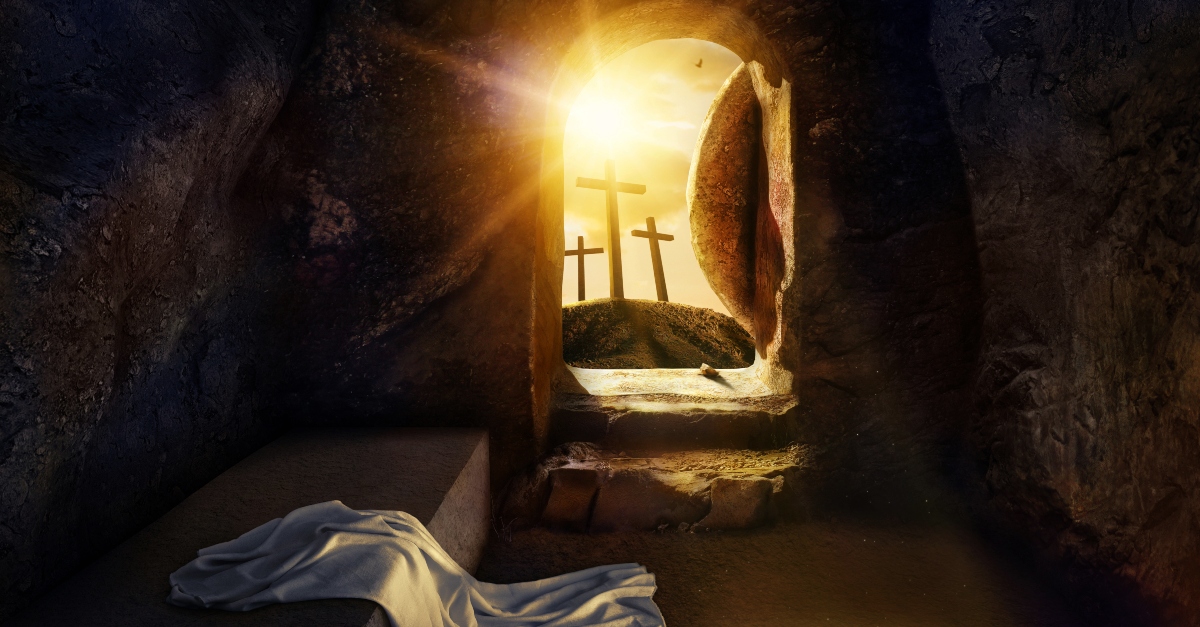
    It is raining in Atlanta today on Easter, and we are living in dark times; and still we will celebrate, for what God is doing even here and now - all in light of the resurrection. Christ is risen; He is truly risen, alleluia!